TLDR: The right outboard size sits between two mistakes: underpowering (a boat that won’t get on the plane) and overpowering (unstable, and legally a problem). Start with the maximum horsepower on your boat’s compliance plate, size toward the upper end using roughly 20 to 40 horsepower per tonne of loaded weight, then match the shaft length to your transom. Get those three right and the rest is trim.
Picking an outboard is one of those decisions where the wrong call follows you for years. Go too small and every trip is a fight to get on the plane with the family and the Esky aboard. Go too big and you have wasted money, added weight the transom was never rated for, and possibly voided your insurance. This guide walks through how to size an outboard properly for Australian conditions, from the compliance plate to shaft length to the 2-stroke versus 4-stroke question, so you buy once and buy right.
Start With the Compliance Plate, Not the Brochure
Before you look at a single engine, look at your boat. Every recreational powered boat sold new in Australia carries an Australian Builders Plate (ABP), and it tells you the two numbers that bound this whole decision: the maximum engine power the hull is rated for, and the maximum load it can carry.
That maximum horsepower figure is not a suggestion. Fitting an ABP to applicable boats is a legal requirement in every Australian state and the Northern Territory, and the plate exists precisely so a buyer can match an engine to the hull safely. As Transport WA puts it, if an incident happens because a boat was overloaded or overpowered, the owner or skipper may have to justify why they did not comply with the limits on the plate. Fit an engine bigger than the plate allows and you are not just risking the boat, you are on the wrong side of that conversation with your insurer and, potentially, the authorities.
The plate lives on the transom, in the cockpit, or near the helm. It shows maximum engine power (in kilowatts, sometimes horsepower too), maximum persons, and maximum load. If your boat is older than the plate system or the plate is missing, the manufacturer’s original rating still applies. Track it down before you spend a cent. For the detail on what the plate must legally show, the Australian and New Zealand Safe Boating Education Group explains the ABP.
One more thing the plate settles: licence and registration. In Australia these are set state by state, not nationally, and small low-powered engines are often exempt from both. What is fine in Queensland may differ in Victoria. Check your own state’s maritime authority before you assume a little tiller-steer tinnie needs a licence or rego.
The Golden Rule: Size Up, Never Over the Max
Here is the rule almost every experienced boatie lands on. If your compliance plate shows a horsepower range, choose toward the top of it. If it shows only a maximum, aim for roughly 80 percent of that figure. So a hull rated to a maximum of 115hp is happiest with something around 90hp.
Why size up rather than play it safe with a smaller engine? Because an underpowered boat is the more common and more frustrating mistake. It struggles to lift onto the plane, wallows in the mid-range, burns more fuel working hard to do what a bigger engine does easily, and leaves you short of grunt exactly when you need it, punching into a headwind or a building chop. An engine sized near the top of the rating cruises comfortably at part throttle, which is easier on the motor and on your fuel bill.
Overpowering is the opposite error and it carries real consequences. Too much engine hangs excess weight off the transom, sits the boat stern-heavy, makes it twitchy at speed, and takes you past the number the hull was tested and certified to. That last part is where warranty and insurance cover can quietly evaporate. The plate is the ceiling. Live just under it.
How to Work Out the Horsepower You Need
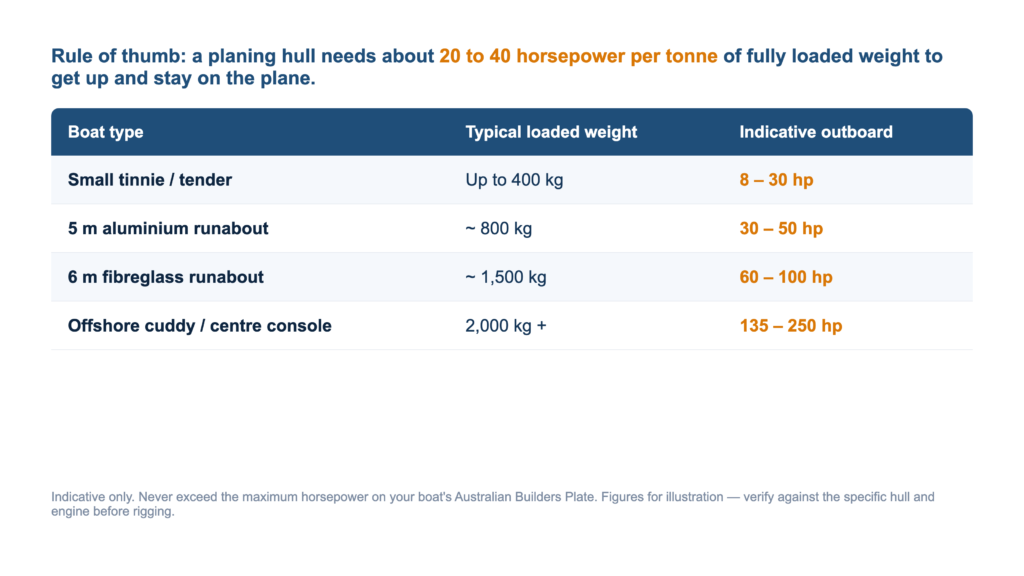
Within the range the plate allows, boat weight is what decides the number. The rule of thumb Australian riggers use is that a planing hull needs roughly 20 to 40 horsepower per tonne of fully loaded weight to get up and stay on the plane. Loaded weight means the boat, the fuel, the gear, and everyone aboard, not the dry hull weight on the brochure.
Work an example through. Say you have a 5 metre aluminium runabout that comes in around 800kg once it is loaded with fuel, tackle and two adults. At 20 to 40 horsepower per tonne, that points to roughly 30 to 50hp. Step up to a 6 metre fibreglass runabout loaded to about 1,500kg and the same maths lands around 60 to 100hp. Where you sit inside that band comes down to how you use the boat.
Use pushes you up, not down. Choose the higher end of the range if you:
- Cross bars or head offshore, where reserve power is a safety margin, not a luxury
- Regularly carry a full load of people and gear
- Tow skiers, wakeboarders or a biscuit
- Run into strong tides or persistent chop on your home waters
Choose the lower end if it is a light boat used mostly on flat, protected water with a couple of people aboard. When in doubt, and inside the plate limit, go up. You can throttle back a big engine. You cannot conjure horsepower a small one does not have.
Shaft Length: The Number People Forget
Horsepower gets all the attention, but the wrong shaft length will ruin a correctly sized engine. Shaft length has to match your boat’s transom height so the propeller sits at the right depth. Too short and the prop ventilates and cavitates, sucking air and losing bite. Too long and you drag extra gearcase through the water and, in the worst case, sit the powerhead too low.
Measure from the top of the transom, where the engine clamps, straight down to the bottom of the hull. Then match it:
- 15 inch (short shaft): small tinnies, tenders and inflatables with a low transom
- 20 inch (long shaft): the most common fit, suits most runabouts and mid-size boats
- 25 inch (extra-long): deeper transoms, offshore boats
- 30 inch (XXL): large offshore hulls, often twin-engine setups
If you are repowering and reusing an existing boat, measure the transom rather than assuming the old engine was right. Plenty of secondhand boats are running the wrong shaft length already.
2-Stroke or 4-Stroke?
Both still have their place, though four-strokes now dominate new sales. The short version:
Four-stroke outboards are quieter, cleaner, smoother at idle and markedly more fuel efficient, especially at trolling and cruise speeds. The trade-off is weight and, historically, upfront cost. For most families, most fishos and most day boats, a four-stroke is the default and the right call.
Two-stroke outboards, particularly modern direct-injection ones, are lighter for the same horsepower, deliver a punchier hole-shot, and cost less to buy. They are thirstier and louder, but the weight saving matters on a small tinnie where every kilo on the transom counts.
If you are repowering an older hull, watch the weight. A modern four-stroke can be noticeably heavier than the two-stroke it replaces, and a transom rated in the two-stroke era may not love the extra mass. Check the rigged weight against your plate’s maximum load, not just the horsepower.
Buying Right Means Living With It for a Decade
An outboard is a long-term relationship. The engine you choose today is the one you will be servicing, sourcing filters and impellers for, and eventually reselling in ten years or more. That makes two things worth weighing before you sign.
First, parts and serviceability. An engine is only as good as your ability to keep it running, and in Australia that means asking how easy it is to get consumables and service parts for the brand and model over its life. Water pump impellers, fuel and water separators, oils, anodes and filters are the difference between a $40 service and a $4,000 powerhead rebuild. The mainstream brands, Yamaha, Mercury, Suzuki, Honda and Tohatsu, are all well supported here, and even discontinued lines like Evinrude still have strong parts availability. Whatever you choose, at Victory Parts we stock genuine and quality aftermarket outboard maintenance parts for all the major brands, held in Australia with same-day dispatch, so a routine service never becomes a month-long wait.
Second, resale. The right-sized engine on the right hull holds value. A hull that is obviously underpowered, or one carrying an engine over its rated maximum, is a harder sell and a red flag to a savvy buyer. Sizing correctly is not just about how the boat runs for you. It protects what you get back when you upgrade.
Frequently Asked Questions
What size outboard do I need for my boat?
Start with the maximum horsepower on your boat’s Australian Builders Plate and stay under it. Within that limit, size by loaded weight using roughly 20 to 40 horsepower per tonne for a planing hull, and lean toward the upper end if you go offshore, carry a full load or tow. A loaded 5 metre aluminium runabout typically suits 30 to 50hp; a 6 metre fibreglass runabout around 60 to 100hp.
Can I put a bigger engine on than the plate says?
No. The maximum on the compliance plate is a legal and safety limit, and exceeding it can void your warranty and insurance and leave you liable if something goes wrong. If you want more power, you need a hull rated for it.
Is it bad to underpower a boat?
Yes, and it is the more common mistake. An underpowered boat struggles to get on the plane, wallows in the mid-range, works harder and burns more fuel, and leaves you short of reserve power when conditions turn. Sizing toward the top of the plate’s range avoids it.
What shaft length outboard do I need?
Measure from the top of the transom to the bottom of the hull. Around 15 inches suits small tinnies and tenders (short shaft), 20 inches fits most runabouts (long shaft), and 25 inches or more suits deeper offshore transoms. The prop needs to sit at the right depth, so match the shaft to the boat, not to the engine you happen to find.
Should I choose a 2-stroke or a 4-stroke outboard?
For most boats, a four-stroke: quieter, cleaner and far more economical at cruise. A modern direct-injection two-stroke is worth considering where light weight and a strong hole-shot matter, such as on a small tinnie. If repowering, check the new engine’s weight against your plate’s maximum load.
Do I need a licence to run an outboard in Australia?
It depends on your state and the engine’s power. Licensing and registration are set by each state’s maritime authority, not nationally, and small low-powered engines are often exempt. Check your own state’s rules before assuming.
Ready to Keep Your Outboard Running Right?
Once you have the right engine on the transom, keeping it there for the long haul comes down to servicing it on time with the right parts. Victory Parts stocks genuine and quality aftermarket parts, oils and consumables for Yamaha, Mercury, Suzuki, Honda, Tohatsu and Evinrude outboards, all held in Australia with same-day dispatch. Browse the range or get in touch and we will help you find the right part first time.
The information in this article is general in nature and provided for guidance only. Victory Parts accepts no responsibility or liability for any action taken, or any loss or damage incurred, as a result of relying on the information in this article.