TLDR: A compression test tells you whether the cylinders in your outboard are still sealing, and it is the single most useful check before buying a used motor. The test itself takes about twenty minutes. Reading the result is where most people come unstuck, because the PSI figures quoted all over the internet are not manufacturer figures, and a healthy two-stroke can read far lower than those numbers suggest. Here is how to run the test properly, and how to judge the result against what the engine makers actually publish.
A compression test is the cheapest look inside a powerhead you will ever get. No pulling the head, no splitting the block, just a gauge, a few minutes and a number per cylinder. It is the check every experienced boatie runs before handing over money for a second-hand outboard, and the one that decides whether a tired motor is worth reviving or worth parting out. The test is simple. Interpreting it is not, and that is where this guide spends most of its time.
What a Compression Test Actually Tells You
Every cylinder in your outboard relies on a seal. The piston rings seal against the bore, the head gasket seals the combustion chamber, and on a four-stroke the valves seal against their seats. When all of that is tight, the cylinder squeezes the fuel and air charge hard enough to make power. When any part of it leaks, the squeeze weakens and the cylinder makes less power than the ones beside it.
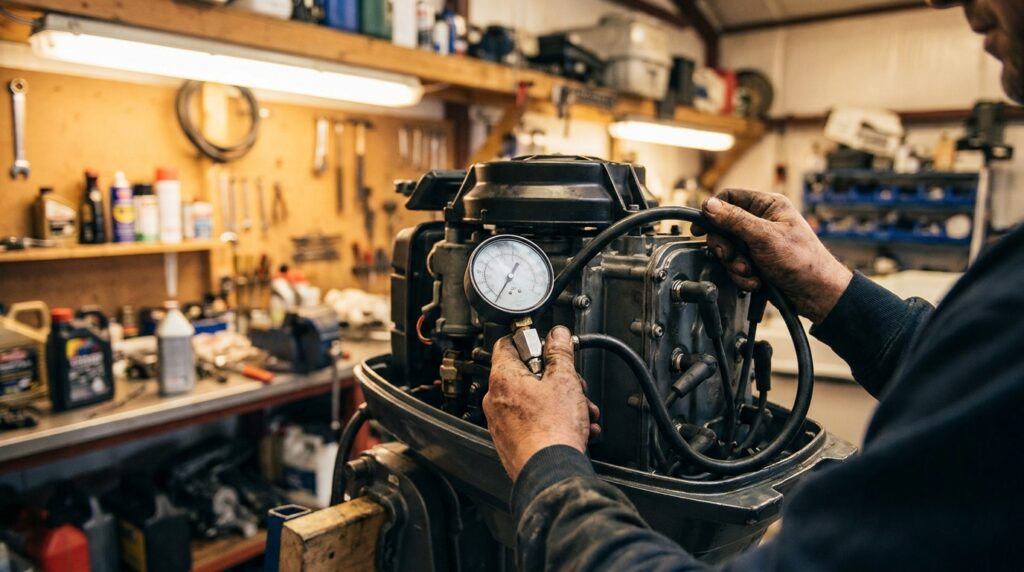
A compression gauge measures that squeeze while the engine is cranking. It cannot tell you which component is leaking on its own, but it tells you where to look, and it tells you whether the powerhead is fundamentally healthy before you spend money on carburettors, injectors, ignition or anything else. If a cylinder will not hold pressure, no amount of tuning will fix how the motor runs.
It is worth being clear about what the test is not. Manufacturers are explicit on this point. Yamaha prints alongside its published figures that they are for reference only, and Suzuki notes in its service literature that its figures are guidelines rather than absolute service limits. A compression test is a screening tool that tells you where to investigate next. It is not a pass or fail verdict on an engine.
What You Need Before You Start
A compression gauge with the correct thread adapter for your engine, a plug spanner, and something to write on. The adapter matters more than people expect. A loose or badly seated fitting bleeds pressure and gives you a low reading on a perfectly good cylinder, which is one of the most common ways a home test sends someone chasing a fault that does not exist.
You will also want a fresh set of spark plugs on hand. You are taking the old ones out anyway, and if the motor has been sitting or running rich, this is the natural moment to replace them.
How to Test Compression on an Outboard, Step by Step
Warm the engine first. Both Yamaha and Suzuki specify testing on a warm engine, and Yamaha’s two-stroke literature calls for around five minutes of running beforehand. You will see advice online insisting the motor must be cold. That advice contradicts the service manuals. A warm engine has the piston and bore at operating clearance, which is the condition the published figures were measured in. Run it on the muffs or in a tank, then shut it down.
Make it safe. Pull the engine stop switch clip. Then disconnect the ignition and, on a fuel injected motor, the injector connectors. Yamaha’s four-stroke procedure calls for disconnecting all injector couplers, and Suzuki calls for disconnecting the safety lanyard. This is not box ticking. You are about to crank an engine with the plugs out, which means raw fuel can be pumped into a hot engine bay while a live ignition system is looking for somewhere to spark.
Blow out the plug wells before you pull the plugs. Yamaha builds this into its procedure and almost nobody mentions it. Compressed air into the recess clears the grit that otherwise drops straight into the cylinder the moment the plug comes out. It costs ten seconds and saves a scored bore.
Remove every spark plug, not just the one you are testing. With plugs still in the other cylinders, the engine has to fight their compression while cranking, the starter turns slower, and every reading comes out low. Lay the plugs out in cylinder order as you go. Their condition is diagnostic in itself, and you want to know which one came from where.
Hold the throttle wide open. This is the step most often skipped and it changes the result significantly. A closed throttle chokes the air the cylinder can draw, so the engine cannot fill properly and the reading drops. Every manufacturer procedure, across Yamaha, Mercury, Suzuki and Honda, specifies wide open throttle. On some motors that means disconnecting the throttle cable and holding the lever open by hand.
Crank until the needle stops climbing. Not for a set number of seconds, and not for a set number of turns. You will find pages online specifying three to five seconds, or five revolutions, or four to six turns. No manufacturer specifies a pull count. They specify cranking until the reading stabilises or peaks, which typically takes several compression strokes. Honda instead specifies a cranking speed, which is a reminder that a tired battery or a dragging starter will quietly flatten every number you record.
Record each cylinder, then do it again. Yamaha’s two-stroke procedure calls for measuring each cylinder three times and averaging the results. Single readings scatter more than people realise, and averaging is what separates a real result from a number you half trust.
The Compression Numbers Quoted Online Are Not Manufacturer Figures
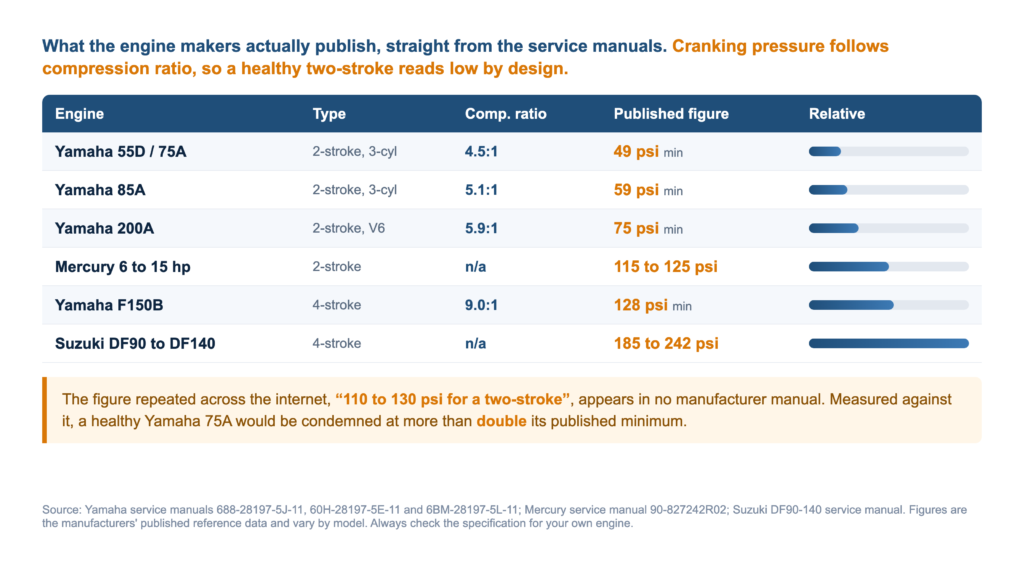
Search this topic and you will be told, over and over, that a healthy two-stroke reads 110 to 130 PSI and a healthy four-stroke reads 180 to 210 PSI. Those numbers are repeated on page after page. They are not published by any engine manufacturer, and for two-strokes in particular they are badly misleading.
Yamaha’s own service manuals set the minimum compression pressure for the 55D and 75A two-strokes at 340 kPa, which is 49 PSI. For the 85A it is 410 kPa, or 59 PSI. For the 200A V6 two-stroke it is 520 kPa, about 75 PSI. Those are Yamaha’s published minimums, from manuals 688-28197-5J-11 and 60H-28197-5E-11. Measured against the internet’s 110 to 130 PSI rule, a Yamaha 75A pulling 90 PSI gets condemned as a worn-out motor. Measured against Yamaha’s actual specification, it is comfortably healthy.
The reason is compression ratio, and it is the part nobody explains. Those Yamaha two-strokes run ratios of 4.5:1, 5.1:1 and 5.9:1. A modern four-stroke like the Yamaha F150B runs 9.0:1. Cranking pressure scales with compression ratio, so a low-compression two-stroke is supposed to read low. It is not a sign of wear. It is the design. Comparing the two on the same PSI scale is like comparing a diesel and a petrol engine on the same fuel economy chart.
Four-stroke figures vary just as widely between engines. Yamaha’s F150B minimum is 880 kPa, about 128 PSI, from manual 6BM-28197-5L-11. Suzuki’s DF90 through DF140 range publishes a standard of 1300 to 1700 kPa, roughly 185 to 242 PSI. Both are healthy engines. Both would be judged differently by a single internet rule of thumb.
The practical takeaway is simple. Find the specification for your engine, by model and year, rather than trusting a general figure. If you are not certain exactly which motor you have, our guides to the Mercury outboard serial number and the Yamaha outboard serial number and model code will pin down the model and year you need before you go looking for its spec.
The Small Four-Stroke Trap: Automatic Decompression
This one catches people out badly, and no other guide on the topic mentions it.
Many small four-stroke outboards have an automatic decompression mechanism. Its job is to bleed off cylinder pressure while cranking so the motor is easy to pull start. It works perfectly, and it means a compression test on a healthy small four-stroke returns a number that looks catastrophic.
Mercury’s service literature for the 4, 5 and 6 horsepower FourStroke specifies compression of 42 PSI, plus or minus 14, while the decompression assembly is operating. That is a maximum of 50 and a minimum of 36. With the decompression assembly disabled, the same engine reads 100 to 130 PSI. Those figures are from manual 90-857138R1.
So a perfectly good little four-stroke reads somewhere in the forties. Someone testing it against an internet rule that says four-strokes should read 180 to 210 PSI concludes the engine is dead and walks away from a motor that has nothing wrong with it. If you are testing a small four-stroke and the number looks alarming, check whether your engine has automatic decompression before you condemn it.
The Gap Between Cylinders Matters More Than the Number
On a multi-cylinder outboard, the most useful thing a compression test gives you is not any single reading. It is the spread between them. Cylinders that share a crankcase, a cooling system and a service history should be doing roughly the same work. When one is well down on the others, something specific has gone wrong with that cylinder.
You will see the ten percent rule quoted almost everywhere as the threshold. It is worth knowing that this figure does not appear in the manufacturer literature. What the manufacturers actually publish is different and generally more forgiving. Mercury’s manual for its 6 to 15 horsepower two-strokes specifies that readings between cylinders should not vary by more than fifteen percent, and that if variance exceeds fifteen percent, or both cylinders read under 100 PSI, the powerhead should be pulled down and inspected. Suzuki works in absolutes rather than percentages, allowing a maximum difference of 100 kPa, about 14 PSI, across the DF90 to DF140 range, and 200 kPa, about 28 PSI, on the DF60 and DF70.
Treat ten percent as a workshop rule of thumb rather than a specification. The principle behind it holds regardless: a big gap between cylinders is a genuine finding, and even readings that are all somewhat low are usually a better sign than one cylinder sitting well below its neighbours.
The Wet Test: Rings or Valves?
If a cylinder reads low, the wet test tells you where the leak is, and it takes about two minutes. Both Yamaha and Mercury build it into their official procedures.
Squirt a small amount of engine oil into the cylinder through the plug hole, then test that cylinder again. The oil temporarily seals the gap between the rings and the bore. What happens next splits the diagnosis cleanly.
If the reading jumps up, the leak is past the rings. You are looking at worn or stuck rings, or a scored bore, and the repair lives in the piston and ring territory. If the reading barely moves, the rings are sealing and the pressure is escaping somewhere the oil cannot reach. On a four-stroke that points to valves, valve seats, valve clearances or the head gasket. On a two-stroke it points to the head gasket or a leaking seal.
That single step turns a vague low reading into a shortlist, which is the difference between quoting a job and guessing at one.
What Low Compression Costs You, and What Causes It
Low compression is almost never the original fault. It is the end result of something else that was left alone. Overheating is the most common cause we see behind a scored bore, and overheating usually traces back to a cooling system that was neglected: a perished impeller, a tired water pump, or a thermostat that stopped opening. Detonation from the wrong fuel, or a two-stroke run on the wrong oil ratio or the wrong oil entirely, does the same job more slowly.
This is the dollar-stakes part. An impeller and a water pump kit is a routine service item. A powerhead rebuild, with pistons, con rods, bearings and a full gasket set, is in another category entirely, and on an older motor it can exceed what the engine is worth. That maths is exactly why a compression test before purchase is worth the twenty minutes it takes.
If you are testing a motor you are thinking of buying, one more piece of Australian context is worth weighing. A motor that has spent its life in salt water without being flushed has a different corrosion history to a freshwater engine of the same age and hours, and that history shows up in cooling passages and cylinder walls long before it shows up in the seller’s description. A compression test on a salt-water motor is not optional.
Frequently Asked Questions
What is good compression on an outboard motor?
It depends entirely on the engine, which is why a single number quoted online is not much use. Manufacturer minimums vary enormously, from around 49 PSI on some Yamaha two-strokes to over 180 PSI on some Suzuki four-strokes. Find the published figure for your specific model, and treat the consistency between cylinders as at least as important as the absolute number.
Should the engine be hot or cold for a compression test?
Warm. Yamaha and Suzuki both specify warming the engine before testing, with Yamaha’s two-stroke literature calling for about five minutes of running. Advice telling you to test cold contradicts the service manuals, and a cold engine gives you readings that were not measured under the conditions the published specifications assume.
Why does my two-stroke read so much lower than a four-stroke?
Because it is designed to. Two-stroke outboards typically run much lower compression ratios, in the range of 4.5:1 to 6:1, against around 9:1 for a modern four-stroke. Cranking pressure follows compression ratio, so a lower reading on a two-stroke is normal rather than a sign of wear.
How much difference between cylinders is too much?
Manufacturers differ. Mercury specifies no more than fifteen percent variance on its small two-strokes, while Suzuki works in absolute terms with a maximum of around 14 PSI difference on some four-stroke ranges. The widely quoted ten percent rule is a workshop convention rather than a published specification. Whichever benchmark you use, a single cylinder sitting well below the others is the finding that matters.
Can an outboard still run with low compression?
Usually yes, which is exactly the problem. A motor with one weak cylinder will often start and idle, and only show itself as rough running, poor performance under load or hard starting. That is why the test is worth doing on a motor that seems to run acceptably, particularly before you buy it.
Do I need a mechanic to do a compression test?
No. It is well within the reach of anyone comfortable pulling spark plugs, and a gauge costs a fraction of a workshop visit. Where a marine mechanic earns their money is the next step: interpreting an unusual result, running a leakdown test to pinpoint the leak, and advising whether a repair is worth it on your particular engine.
The information in this article is general in nature and provided for guidance only. Victory Parts accepts no responsibility or liability for any action taken, or any loss or damage incurred, as a result of relying on the information in this article.
Get the Parts to Put It Right
A compression test tells you what your outboard needs. Getting it back on the water is the easy part. Victory Parts stocks genuine and quality aftermarket parts for Yamaha, Mercury, Suzuki, Honda, Tohatsu, Johnson and Evinrude outboards, from spark plugs and gasket kits through to piston kits and full rebuild components, all held in Australia with same-day dispatch. Browse the range or get in touch with your engine model and we will help you find the right part first time.