Why a Marine Battery Is Not Just a Car Battery
Plenty of people have put a cheap automotive battery in a boat and got away with it for a season. It is still the wrong part, and the reason is vibration.
A car battery lives on a sprung chassis on a sealed road. A battery in a boat gets slammed repeatedly as the hull lands off a chop, and that shock goes straight through the mounting into the plates inside the case. Marine batteries are built with heavier plates, more internal bracing and stronger separators specifically to hold up to that. An automotive battery in the same spot sheds active material off its plates, loses capacity early, and often fails without much warning.
The second difference is the environment. Salt air corrodes terminals and any exposed connection, and a boat battery frequently sits for weeks between uses rather than being topped up daily by a commute. Between the pounding, the salt and the long idle periods, a boat is simply a harder place to be a battery, and the construction has to account for it.
Cranking, Deep Cycle and Dual Purpose
Marine batteries fall into three broad types, and choosing the wrong one is the most common and most expensive mistake buyers make.
- Cranking, or starting. Built to deliver a very large current for a few seconds to turn the engine over, then be immediately recharged by the motor. They use more, thinner plates for maximum surface area and high current, which is exactly what an outboard starter needs. They do not like being run down deep, and repeatedly flattening one will shorten its life quickly.
- Deep cycle. Built the opposite way, with fewer, thicker plates that tolerate being discharged well down and recharged again and again. This is what runs a sounder, lights, a fridge or an electric motor over a long day. Ask one to deliver a big starting current and it will do it poorly.
- Dual purpose. A compromise that will start an engine and take moderate cycling. Sensible on a smaller boat with one battery and a modest electrical load. On a boat with real house loads, two purpose-built batteries beat one compromise battery every time.
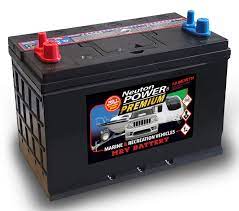
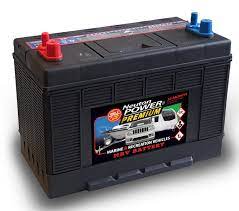
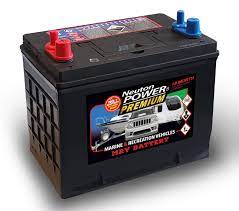
Victory Parts’ current range is built around starting and general boat duty, in three capacities. If you are running heavy house loads at anchor for long periods, that is a genuinely different job and you should be looking at a dedicated deep cycle setup for it.
CCA and Amp Hours: Which One Matters for Your Outboard
Every marine battery carries two headline numbers, and buyers routinely fixate on the wrong one.
CCA, or cold cranking amps, is the current the battery can deliver for 30 seconds while holding a usable voltage, measured at minus 18 degrees. It is a cold-climate test, which is why it looks conservative in Australian conditions, but it is the number that tells you whether the battery will spin your motor over. Some marine batteries are also rated in MCA, or marine cranking amps, which is the same test run at 0 degrees. Because it is a warmer test the battery pushes more current, so an MCA figure is typically around 25 per cent higher than the CCA figure for the same battery. Never compare a CCA number on one battery against an MCA number on another and conclude one is stronger.
Amp hours, or Ah, is capacity: how much energy the battery holds and therefore how long it will run your electronics with the motor off.
For a boat that starts the motor and runs modest electronics, CCA is the number to buy on. Get the cranking current right first and treat capacity as the secondary consideration. It is only when you are sitting at anchor for hours running a sounder, lights and a fridge that Ah becomes the number that decides your day. Victory Parts’ range spans 640 CCA at 80Ah, 750 CCA at 105Ah, and 1000 CCA at 120Ah, so both figures rise together as you move up the range.
Matching a Battery to Your Outboard
Start with what the engine manufacturer specifies for your motor, because that minimum cranking figure is not a suggestion. Bigger motors need more current to turn over, and larger fourstrokes with higher compression ask more of a battery than a small two stroke does.
From there, adjust upwards for how you actually use the boat. A modern EFI or direct injection outboard runs fuel pumps, an ECU and injectors, and it needs solid voltage while cranking to fire up properly, so a battery that is merely adequate can cause hard starting and intermittent electronic faults that look like engine problems. Add up your other loads too. A sounder, chartplotter, VHF, nav lights, a stereo and a livewell pump all draw from the same battery, and if you spend hours at anchor with the motor off, buy more capacity than the bare minimum.
If you are unsure what suits your motor, send us the engine make, model, year and horsepower and we will point you at the right battery.
Your Outboard’s Charging System Is Not a Battery Charger
This is the single most misunderstood thing about boat electrics, and it is what kills most marine batteries early.
Your outboard has a stator and a rectifier or regulator that produce a modest charging current while the engine is running. That system is designed to top up a healthy battery after it has been used to start the motor. It is not designed to recover a battery that has been run flat, and it will not do it. Idling around for an hour after flattening a battery at anchor puts a fraction of the charge back that the battery actually needs.
A battery that is repeatedly run down and then only partially recharged sulphates, loses capacity permanently, and dies long before it should. If you regularly draw your battery down, it needs to go on a proper mains charger between trips. Chronic undercharging looks exactly like a faulty battery, and plenty of batteries get replaced when the real problem was never getting them back to full.
It is also worth knowing the failure runs both ways. If a battery will not hold charge, the fault may not be the battery at all. A failed stator or a faulty rectifier or regulator means the motor never charges properly, and a brand new battery fitted to a boat with a dead charging circuit will be flat again within a few trips. If you are on your second battery in quick succession, test the charging output before buying a third. Our outboard charging system parts cover the stators, rectifiers and regulators behind that job.
Running More Than One Battery
Once you have a decent electrical load on board, one battery starts to look thin. The risk is obvious: spend the afternoon at anchor with the sounder and the stereo going, and you can find yourself with nothing left to start the motor.
The usual answer is two batteries, one dedicated to starting and one for house loads, with a switch or isolator so the two are kept apart and the starting battery is protected. That way the house side can be run down without ever touching the charge you need to get home. On a boat with a big house load and a long day at anchor, it is the difference between an inconvenience and a call for help.
Whichever way you set it up, mount every battery in a secure box or tray, strapped down so it cannot shift. An unrestrained battery in a seaway is heavy, it will chafe through its own cables, and a loose terminal against the hull is a real fire risk.
Looking After a Marine Battery in Salt Water
Salt air attacks the terminals first. Keep them clean, tight and protected with terminal grease or a proper protectant, and check them a few times a season. A corroded terminal adds resistance, and added resistance shows up as slow, laboured cranking that owners usually blame on the battery itself when a clean and retighten would have fixed it.
Keep the battery charged rather than letting it sit flat, especially over winter or any long lay-up, because a flat battery left standing sulphates and may never come back. Keep the top of the battery clean and dry, since a wet, salty film across the terminals will slowly discharge it on its own. Make sure the mounting stays tight, as a battery that is free to move is a battery being shaken apart. Finally, check the age of the battery before you chase an electrical gremlin. Marine batteries lead a hard life and a tired one that still starts the motor on a warm day may not have enough left when you need it.