The short answer: Propeller pitch is how far a prop would move forward in one full turn if its blades gripped the water perfectly, the way a screw bites into timber. A 17 inch pitch prop would move 17 inches per turn; in real water it moves a little less. More pitch lowers your wide open throttle (WOT) RPM, less pitch raises it. Choose the pitch that gets your motor to the upper part of its WOT range with a normal load aboard. Each inch is worth roughly 150 to 200 RPM.
By Victory Parts, Last updated October 2026
A boat that won’t get on the plane loaded, a motor bouncing off the rev limiter, a top speed that dropped after a prop change: most of the time, pitch is the cause. Here’s what it means, how it sets your RPM, and how to work out the right one, with a prop pitch calculator to do the sums.
What Propeller Pitch Means
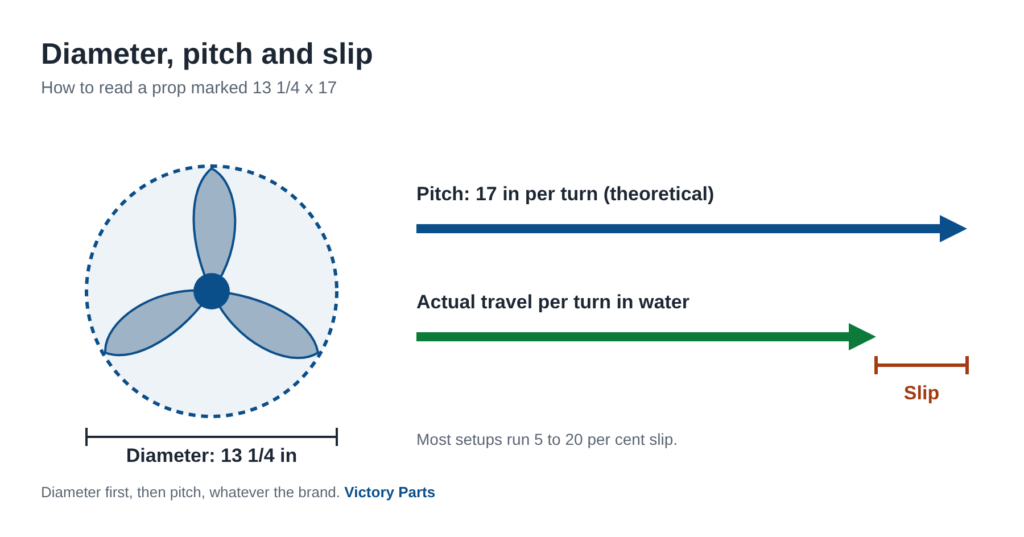
The easiest way to picture pitch is a wood screw. Turn a screw once and it pulls itself into the timber by a set distance, because its thread is cut at a set angle. A propeller’s blades are angled in the same way, like a thread wrapped around the hub, and pitch is the distance that angle would carry the prop forward in one full turn if it were biting into something firm.
So a 17 inch pitch prop would move 17 inches with every turn. A 21 inch pitch prop has steeper blades and would move 21 inches. That’s why more pitch means more speed per turn, but takes more power to swing.
Water isn’t timber. It gives way a little as the blades push against it, so the prop never quite covers its full pitch. That shortfall is slip, and every prop has some.
Diameter is the other number: the width of the circle the blade tips trace. Every brand writes them diameter first, so a 13 1/4 x 17 prop is 13 1/4 inches across with a 17 inch pitch.
Prop Pitch Sets Your WOT RPM
Every outboard has a recommended WOT RPM range in its owner’s manual, and pitch is how you put the engine inside it. Add pitch and WOT RPM drops; take it away and RPM rises. Running outside the range can cause serious engine damage, so this isn’t only about top speed.
Aim for the upper part of the range with a normal load aboard. On a motor rated at 5,000 to 6,000 RPM, that’s about 5,700 to 6,000. As a rule of thumb, each inch of pitch is worth roughly 150 to 200 RPM.
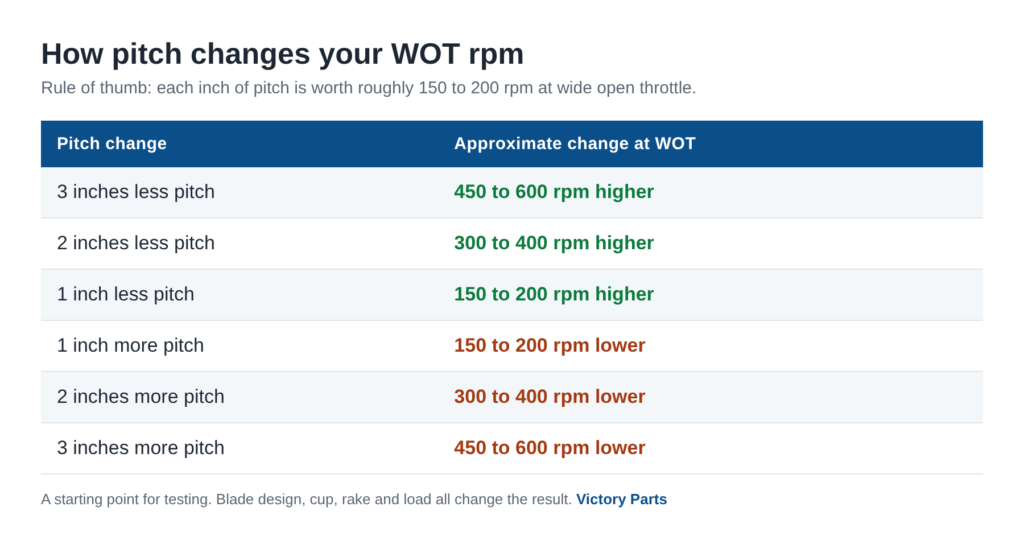
Say your motor tops out at 5,300 RPM on a 17 inch prop, loaded the way you normally fish. You need 400 to 500 RPM more, which is two to three inches less pitch. A 15 should land around 5,600 to 5,700; a 14 should get you near the top of the range.
Prop Pitch Calculator
You’ll need your WOT RPM from the tacho, your gear ratio from the owner’s manual or spec sheet, the pitch of your current prop, and your top speed from a GPS rather than the dash speedo.
The maths behind the boat propeller calculator
- Prop RPM = engine RPM ÷ gear ratio
- Theoretical speed (km/h) = prop RPM × pitch in inches × 0.001524
- Slip (%) = (1 – GPS speed ÷ theoretical speed) × 100
The 0.001524 converts inches per minute into kilometres per hour. Divide km/h by 1.852 for knots.
Worked example. 5,800 RPM through a 2.00:1 gearcase spins the prop at 2,900 RPM. On a 17 inch pitch, that’s a theoretical 75.1 km/h (40.6 knots). If the GPS shows 63 km/h, slip is about 16 per cent.
What Slip Tells You
Slip comes from the angle a blade needs to make thrust, so some slip is normal. Mercury Racing, which publishes its own slip calculator, puts most setups between 5 and 20 per cent. Above 20 per cent, a different prop or a change in engine height could probably improve things. A negative figure usually means the gear ratio or tacho reading is wrong.
Slip isn’t a measure of efficiency, so use it to compare runs. If it jumps with the same prop and load, check the prop and the hull.
How to Test Your Current Prop
- Load the boat the way you normally run it: usual crew, fuel, gear and ice. A prop that suits two people can leave a loaded boat struggling, and heavier loads call for less pitch.
- Pick calm water, run with and against the current or tide, and average the two.
- Trim out until speed peaks without the prop ventilating, then hold full throttle.
- Once RPM and GPS speed settle, write down both, with the load and trim.
- Compare the RPM with your manual’s WOT range and run the numbers through the calculator.
Then read the result against this table:
Pitch Isn’t the Only Number
Two props with the same pitch can behave differently because of:
- Diameter. Larger diameters push more water and suit slower, heavier boats; smaller ones suit lighter boats or higher RPM.
- Cup. The curl in the blade edges. The right amount reduces ventilation and slip; too much adds steering torque and limits RPM.
- Rake. How far the blades lean back. High rake suits high engine mounts; low rake can help the hole shot.
- Blades and material. Four blades give more acceleration but can cost top speed. Stainless allows thinner, more efficient blades than aluminium.
Diameter usually shrinks as pitch goes up within a prop series. One Mercury series in our range runs 13 3/4 x 15, 13 1/4 x 17 and 13 x 19, so when you change pitch, order the full size or the part number.
When the Problem Isn’t the Pitch
- A spun hub. The engine revs hard but the boat barely moves, because the hub has let go inside the prop. Impact, age and exhaust heat are the usual causes, and that heat often traces back to a worn water pump impeller.
- Blade damage. Even light dings from bottom contact cost performance, especially on aluminium props.
- Low engine power or trim faults. These can look like a prop problem when a boat won’t plane. Our outboard maintenance tips cover the service items that keep a motor making its power.
Frequently Asked Questions
Is higher or lower propeller pitch better for speed?
Higher pitch gives more theoretical travel per revolution, but only if the motor can still reach its WOT range. If extra pitch drags the RPM below the range, you lose power and often lose speed too. The fastest prop is usually the highest pitch that still lets the engine reach the upper part of its range with a normal load.
What happens if my propeller pitch is too high?
The engine can’t reach its recommended WOT RPM, and running outside that range can cause serious engine damage. It’s worth fixing, not living with.
How do I find the pitch of my prop?
It’s marked on the prop as diameter x pitch, such as 13 1/4 x 17. If the marking has worn off, use the part number from your parts diagram, or send us your motor’s model and serial number.
Where do I find my gear ratio for the prop pitch calculator?
In your owner’s manual or the engine’s specification sheet. Ratios vary between models, so check yours rather than assuming.
Found the pitch you need? Browse our boat propellers, or email online@victoryparts.com.au with your motor’s model, serial number and current prop, and we’ll match the right one.
About the author
Victory Parts.
Victory Parts supplies outboard parts to boaties, marine workshops and mechanics across Australia from its warehouse at Kunda Park on the Sunshine Coast, with propellers, service parts and steering for Yamaha, Mercury, Suzuki, Honda, Tohatsu, Johnson and Evinrude motors.
This information is general in nature and doesn’t take your specific boat, motor or conditions into account. Always check your owner’s manual or the manufacturer’s specifications before fitting parts or doing maintenance, and talk to a qualified marine mechanic if you’re unsure. Not sure what fits? Email online@victoryparts.com.au with your engine model and we’ll help you find the right part.