TLDR: Yes. Johnson and Evinrude outboard parts are still readily available in Australia, and BRP publicly committed to keeping service parts flowing when it stopped building the engines. What has changed is where you get them. BRP no longer runs an Australian Evinrude website or an Australian dealer locator, so the practical network is now the independent parts specialists. Routine service items are easy. Model-specific hard parts and electronics take more finding, which is the real argument for staying on top of maintenance rather than rushing into a repower.
If you own an Evinrude or an older Johnson, you have probably had the same conversation at the ramp more than once. Someone tells you the brand is dead, parts are drying up, and you should repower before it is too late. It makes for a good yarn. It is also mostly wrong, and it has talked a lot of people out of perfectly good motors. Here is the actual position on Johnson and Evinrude outboard parts in Australia, what the manufacturer committed to in its own words, and how to tell which parts will be easy and which will take some hunting.
The Short Answer
Parts are available. Consumables and routine service items for these engines are stocked in Australia right now, ship the same day, and are not difficult to get. The aftermarket for Johnson and Evinrude is deep because these engines sold in enormous numbers over a very long run, and a large installed base keeps a parts supply alive long after the factory stops.
The honest qualification is that availability is not uniform across every part number. Water pump kits and gaskets are one thing. A model-specific electronic control module for a late direct-injection engine is another. The rest of this article is about telling those two situations apart.
What Actually Happened to Evinrude and Johnson
The history matters because it explains why the parts situation is better than the ramp gossip suggests.
Both brands lived under Outboard Marine Corporation, which collapsed into bankruptcy. Bombardier acquired the engine assets out of that bankruptcy, and the sale included the Evinrude and Johnson brands along with the Ficht fuel injection technology. When Bombardier later spun off its recreational products division, those assets went with it to the company now known as BRP.
Johnson was wound down well before Evinrude. Under OMC it had been repositioned as the four-stroke brand, and for a period those four-strokes were not OMC engines at all. They were built by Suzuki, then painted and badged as Johnsons so dealers had four-strokes to sell alongside the two-stroke Evinrudes. BRP cut that supply arrangement back and it ceased entirely a couple of model years later. By the final North American model year the Johnson line had shrunk to three four-strokes and a two-stroke kicker, and the brand was quietly retired rather than formally discontinued.
Evinrude ran on much longer. BRP eventually announced it would discontinue production of the Evinrude E-TEC and E-TEC G2 outboard engines, with company president and chief executive José Boisjoli citing the impact of COVID-19 on a business segment that was already facing challenges. BRP signed an agreement with Mercury Marine to supply engines to its boat brands. In Australia that flowed straight through to the water, with Telwater brands including Quintrex, Stacer, Savage and Yellowfin moving to Mercury.
One detail is worth pausing on, because it is the thing almost every discussion gets wrong. That announcement covered the E-TEC and E-TEC G2 only. Every Johnson ever built, and every carburetted Evinrude two-stroke, had already been out of production for well over a decade by then. If you own an older motor, the announcement everyone talks about did not actually change anything about your engine.
What BRP Committed To, In Its Own Words
This is the part that gets paraphrased into panic, so it is worth quoting properly.
In the announcement itself, BRP said it would continue to supply customers and its dealer network with service parts, and would honour its manufacturer limited warranties. BRP also ran a dedicated support page for Australian owners at the time, which answered the question directly. Asked whether owners would have difficulty finding parts, the answer given was no, with BRP stating it was committed to providing the parts customers would need for maintenance and repair. Asked whether owners could keep going to their Evinrude dealer for maintenance and repair, the answer was that most Evinrude dealers would continue to provide those services.
That same commitment language still appears today on BRP’s Evinrude owners resources, which continues to host warranty terms, extended service contract terms and recall information.
Read the wording carefully, though, because it is doing precise work. BRP said parts “as needed” and parts “that our customers will need”. It did not attach a duration, a volume, or a guarantee about any particular part number. You will find claims online that BRP promised ten years of parts support, or that support runs to a specific year. We could not attribute that to BRP in any form, and BRP’s own statements contain no timeframe at all. Treat any specific end date you see quoted as someone’s guess rather than a commitment.
The Australian Picture Has Quietly Changed
Here is something no other Australian parts supplier seems to have told owners, and it is worth knowing because it changes where you should be looking.
BRP no longer operates an Australian Evinrude presence. The old Australian Evinrude website no longer exists as a site and now redirects to the United States site. There is no Australian version of the Evinrude site to redirect you to, and the official dealer locator now offers only United States, Canadian and United Kingdom searches. There is no Australian option in it.
None of that means parts have stopped. BRP’s global systems are still online and still usable from Australia, including the official BRP parts catalogue for looking up part numbers. What it does mean is that the practical Australian support network is no longer a manufacturer-run one. It is the independent parts specialists, the aftermarket suppliers and the dealers who chose to keep servicing these engines. If you have been waiting for an official Australian channel to tell you what to do, it is not coming. Go direct to a supplier who stocks the parts.
Which Engine Do You Actually Have?
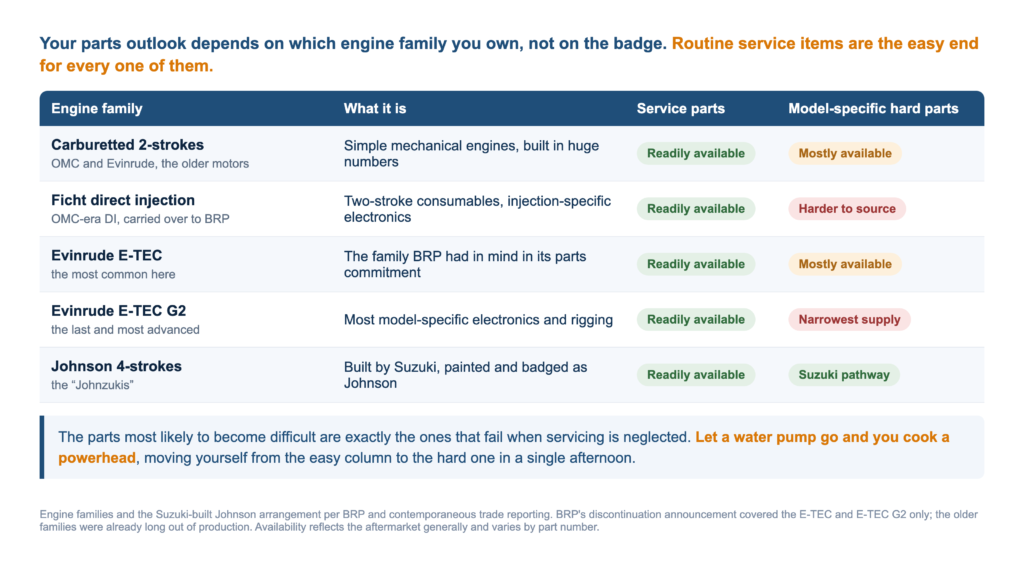
“Evinrude” and “Johnson” cover several very different engines, and your parts outlook depends far more on which family yours belongs to than on the badge.
Carburetted OMC and Evinrude two-strokes. The oldest and, counterintuitively, often the easiest to keep running. Simple mechanical engines, huge production numbers, and a mature aftermarket. Carburettor kits, water pump kits, ignition components and gaskets are all straightforward to source.
Ficht direct injection. The OMC-era direct injection technology that came across to Bombardier with the brands. Mechanically these need the same consumables as any two-stroke. The electronics are where they get specific.
E-TEC. The engine most Australian Evinrude owners are running. Well supported by the aftermarket for service items, and the family BRP had directly in mind when it committed to continued parts supply.
E-TEC G2. The last and most sophisticated of them, with the most model-specific electronics and rigging. Service parts are fine. Anything G2-specific is the narrowest supply of the lot.
Johnson four-strokes. If yours is one of the Suzuki-built engines, you are in a better position than you probably realise. They are Suzuki engines under the paint, which opens up a parts pathway that has nothing to do with BRP at all. This is genuinely useful to know and almost nobody says it out loud.
Which Parts Are Easy, and Which Take Hunting
The useful way to think about this is not brand by brand. It is consumables against hard parts.
Routine service and wear items are the easy end, and it is not close. Impellers and water pump kits, gaskets and seals, anodes, filters, spark plugs, carburettor kits, fuel pumps, ignition components and gear case seal kits are all stocked for these engines and dispatched from Australia. These are the parts a well-kept motor actually consumes, and they are the parts that keep it alive.
The harder end is model-specific hard parts and electronics. Powerheads, gearcases, and engine management components for the direct-injection families are made in smaller numbers, are specific to fewer engines, and have no meaningful aftermarket equivalent. Nobody is tooling up to reproduce a control module for a discontinued engine family.
That split leads to a genuinely practical conclusion. The parts most likely to become difficult are exactly the ones that fail when routine maintenance is neglected. Let a water pump go and you cook a powerhead, and you have moved yourself from the easy column to the hard column in a single afternoon. On a discontinued engine, preventative servicing is not just about cost. It is about staying in the part of the catalogue that is still well stocked.
How to Identify Your Engine Before You Order
Getting the right part for these engines starts with the model number, not the horsepower. Evinrude model numbers in particular encode the year in letters rather than digits, which catches people out constantly when they are working through a parts lookup and cannot find their engine.
BRP still publishes its Evinrude model number reference guides covering both the early and later model ranges, and they remain the authoritative way to decode what you have. Our own guide to the Johnson outboard serial number and model code walks through where to find the identification tag and how to read it.
Have the model number, the serial number and the horsepower ready before you order. On engines this varied, those three together are what separates a part that fits from a part that nearly fits.
Should You Repower?
Not on account of the brand being discontinued, no. That is the wrong reason.
A well-maintained Evinrude with sound compression and a healthy cooling system has years of service left, and replacing it is a substantial spend to solve a problem you do not currently have. The sensible approach is to keep servicing it properly, keep a relationship with a supplier who actually stocks the consumables, and make the repower decision on the engine’s own condition and on your timeline.
The point at which the calculation genuinely changes is when a major hard part fails on a direct-injection engine. If a powerhead or an engine management component goes on a late-model E-TEC, the repair cost against the engine’s value is a real conversation. That is a condition-based decision, not a badge-based one. If and when the day comes, treat it as a fresh brand choice and weigh the parts and service network as carefully as the spec sheet, which is exactly what our guide to the top outboard motor brands is for.
Frequently Asked Questions
Are Evinrude parts still being made?
Service parts continue to be supplied. When BRP discontinued production of the Evinrude E-TEC and E-TEC G2, it stated it would continue supplying customers and dealers with service parts and would honour its manufacturer limited warranties. Alongside that, a substantial aftermarket produces consumables and service components for these engines independently of BRP.
How long will Evinrude parts be available?
BRP has not published an end date. Its commitments refer to supplying the parts customers need for maintenance and repair, without specifying a duration. You will see specific timeframes quoted online, including a ten year figure, but these cannot be traced back to BRP and should not be relied on. What can be said is that the installed base is large and the aftermarket for routine service parts is active.
Can I still get parts for a Johnson outboard in Australia?
Yes. Johnson and Evinrude share a great deal of componentry, and suppliers generally stock them together for that reason. Older carburetted Johnsons are well served by the aftermarket. If yours is one of the later four-strokes built by Suzuki and badged as a Johnson, you also have a parts pathway through the Suzuki side of that engine’s identity.
Is my Evinrude warranty still valid?
BRP stated it would honour its manufacturer limited warranties and extended service contracts, and it continues to publish warranty and extended service contract terms on its owners resources. Whether a specific engine remains within its coverage period is a question for those terms and for the engine’s own history.
Do I need genuine parts, or is aftermarket acceptable?
Both have a place. Quality aftermarket parts are widely used for routine service items on these engines and are often what keeps an older motor economical to run. What matters is that the part is correct for your model and fitted properly. If your engine is still within a warranty period, check how the terms treat parts and fitment before you commit.
Should I sell my Evinrude before it loses value?
There is no need to make a rushed decision. The engines still run, parts for routine servicing are available, and a well-kept motor holds up. Base the decision on the condition of your engine and what you want from it, not on the news that production stopped.
The information in this article is general in nature and provided for guidance only. Victory Parts accepts no responsibility or liability for any action taken, or any loss or damage incurred, as a result of relying on the information in this article.
Keep Your Evinrude or Johnson on the Water
Victory Parts has one of the deepest Johnson and Evinrude ranges in Australia, covering everything from carburettor kits and water pump components through to gaskets, seals, ignition and gear case parts. Stock is held here, dispatched the same day, and priced so that keeping an older motor going stays worth doing. Browse the Johnson and Evinrude range or get in touch with your model and serial number and we will help you find the right part first time.