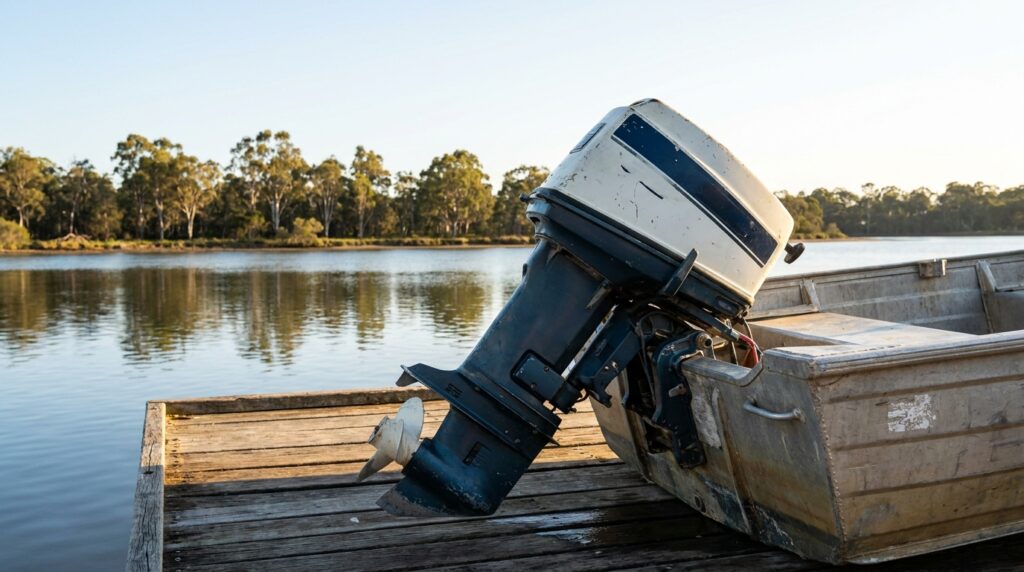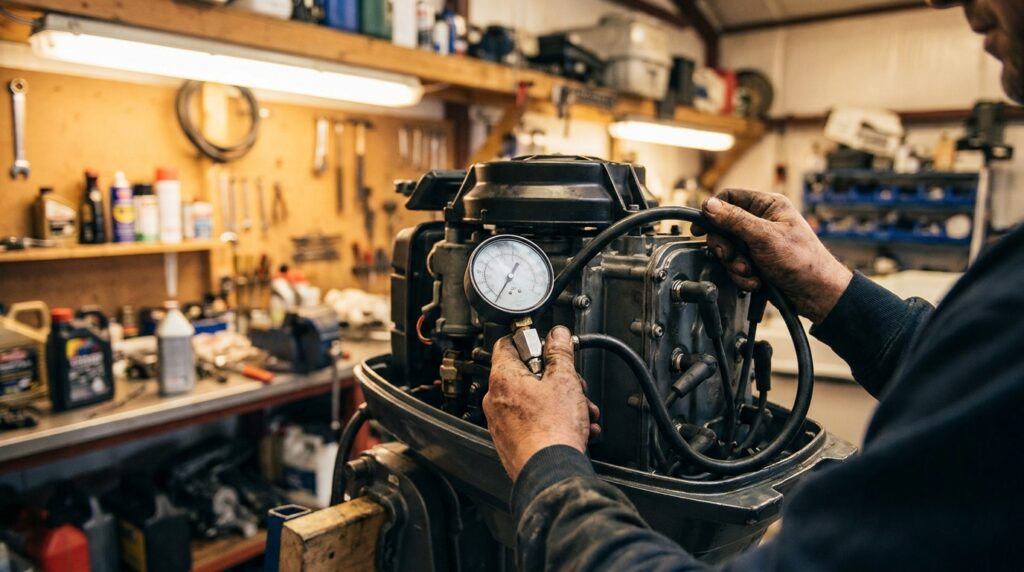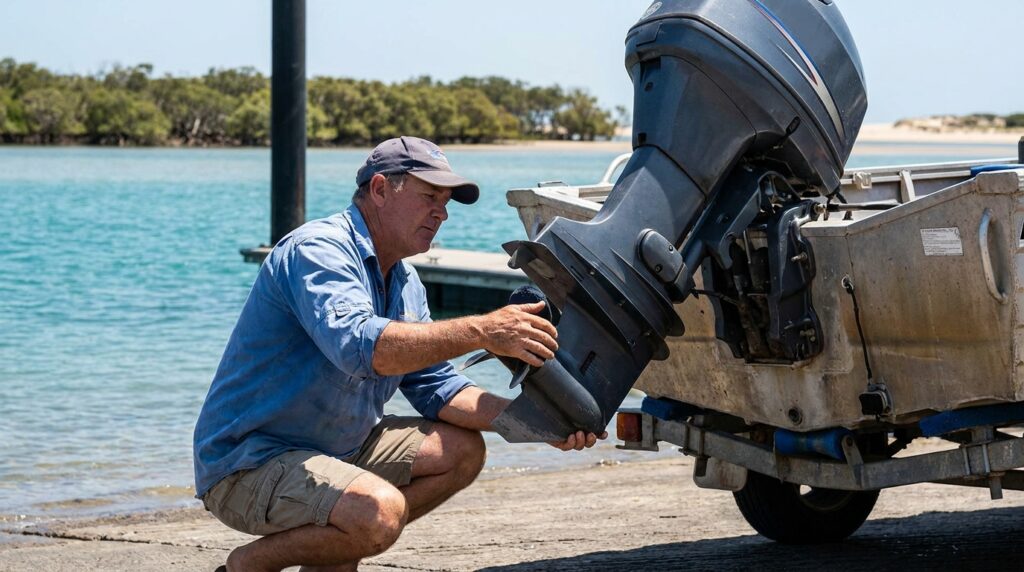

Johnson outboards powered a generation of Australian boating. If you’re working on one today — or just bought one second-hand — you’ve probably discovered that figuring out exactly what you have isn’t as straightforward as it is with a newer motor.
Johnson production ended in 2007, which means every Johnson on the water is at least 17 years old. Many are 30, 40, even 50+ years old. ID plates get corroded. Stickers peel. Paperwork disappears.
This guide covers everything you need to correctly identify your Johnson outboard — where the serial number is, how to decode the model code across three different eras, how to use the INTRODUCES cipher, what the Johnson/Evinrude relationship means for parts availability, and where to source parts in Australia today.
Where to Find the Serial and Model Number on a Johnson Outboard
Johnson outboards carry their identification on a metal tag or sticker called the nameplate or ID tag. Depending on the age of your motor, there are a few places to check:
- Primary location — the swivel bracket: On most Johnson outboards, the ID tag sits on the swivel bracket (also called the transom mounting bracket) on the starboard side of the motor. This is the most common location across all eras.
- Secondary location — the powerhead: Model and serial numbers are also stamped or tagged on the powerhead itself. On some models this is a separate plate near the cylinder block.
- Backup location — the freeze plug: If the ID tag is damaged, worn, or missing entirely, check the freeze plug on the powerhead. Yamaha stamped serials into their block — Johnson did something similar here. The serial number is often stamped into or near the freeze plug and survives when the external tag doesn’t.
Tip: Older motors (pre-1970s) often had a metal plate rather than a sticker, which means the numbers are embossed rather than printed. Get a torch and look at it at an angle — it’s much easier to read that way.
Once you’ve found the tag, you’ll see two key pieces of information: a model number and a serial number. On 1980+ motors, the model number is where the year is encoded. On older motors, the approach is different — see the era-by-era breakdown below.
Decoding Johnson Outboards: The Three Eras
Johnson’s identification system changed significantly over the decades. There are three distinct approaches depending on when your motor was made.
Era 1: Pre-1969 Motors
Johnson outboards made before 1969 used year-specific model numbers — the model number itself was tied to a specific year of production. There’s no universal cipher to decode these; you’ll need to cross-reference the model number against Johnson’s historical records or consult an experienced parts interpreter.
The serial number on these motors is the primary identification tool. If you have a pre-1969 Johnson and need parts, the best approach is to email us at online@victoryparts.com.au with the full model number, serial number, and any other details visible on the tag — our team can usually track down the right components.
Common in Australia: Popular pre-1969 models on Australian waterways include the Johnson Sea-Horse range in various HP configurations from the 1950s and 1960s. These are still serviceable with quality aftermarket parts.
Era 2: 1969–1979 Motors
From 1969, Johnson introduced a more structured model numbering system that embedded the year directly into the model number using the last two digits.
How it works: The last two digits of the model number are the year of manufacture. A model number ending in –79 was made in 1979. Ending in –74 = 1974. Simple.
Example: A model number of J33ELU74A = Johnson, 33hp, electric start, long shaft, 1974, suffix A.
Tip: The year digits appear at the end of the model number, just before any suffix letter. Don’t confuse them with the HP number at the start.
Era 3: 1980–2007 Motors (The INTRODUCES Cipher)
From 1980 onwards, Johnson dropped the year-in-model-number approach and switched to an encoded system using the acronym INTRODUCES. This is the system you’ll encounter on the vast majority of Johnson motors in Australia today.
The cipher: Each letter in INTRODUCES corresponds to a number:
| Letter | I | N | T | R | O | D | U | C | E | S |
| Number | 1 | 2 | 3 | 4 | 5 | 6 | 7 | 8 | 9 | 0 |
The year is encoded as two letters near the end of the model number — those two letters, when decoded using the INTRODUCES cipher, give you the last two digits of the model year.
Example: A model number ending in EE = 9 and 9 = 1999. Ending in CS = 8 and 0 = 1980. Ending in IN = 1 and 2 = 2012.
Full worked example: J70PLEEA = Johnson, 70hp, power trim, long shaft (20”), 1999 model year, suffix A.
Johnson production ran until 2007, so the latest model year you’ll see is 2007 — encoded as OO (5 and 5) in the model number… wait, that’s 55. Actually, 2007 = NT (2+3 = no, let’s be precise):
| Year | Encoded letters | Year | Encoded letters | Year | Encoded letters |
| 1980 | CS | 1990 | OD | 2000 | SS |
| 1981 | CI | 1991 | OI | 2001 | SI |
| 1982 | CN | 1992 | ON | 2002 | SN |
| 1983 | CT | 1993 | OT | 2003 | ST |
| 1984 | CR | 1994 | OR | 2004 | SR |
| 1985 | CO | 1995 | OO | 2005 | SO |
| 1986 | CD | 1996 | OD | 2006 | SD |
| 1987 | CU | 1997 | OU | 2007 | SU |
| 1988 | CC | 1998 | OC | ||
| 1989 | CE | 1999 | EE |
Tip: The two INTRODUCES letters appear near the end of the model number, just before any single-letter suffix (like A, B, or C) that indicates the production run. Ignore the suffix for year identification.
How to Read a Full Johnson Model Code (1980–2007)
Beyond the year, the model code tells you everything about how the motor is configured. Here’s how to break it down.
Using the worked example: J70PLEEA
Brand Prefix
| Code | Brand |
| J | Johnson |
| E | Evinrude |
Horsepower
The number after the brand prefix is the rated horsepower. 70 = 70hp.
Design Feature Codes
The letters after the HP number describe the motor’s configuration. This is the most complex part of the code — there are many possible combinations.
| Code | Meaning |
| P | Power trim / power steering |
| T | Electric start, trim & tilt |
| E | Electric start (remote steering) |
| R | Rope start, tiller |
| D | Remote electric |
| M | Manual tilt, electric start (to 1998) / Manual tilt V4 (1999+) |
| 4 or FE/FR/FRE | 4-stroke motor |
| F / FS / FT | FICHT™ fuel injection (1998+) |
| C | Counter rotation |
| J | Jet drive |
| RA | Australia rope start (AU-specific code) |
| U | Manual tilt |
| G | Special styling |
| S | Sail / special styling (Evinrude white) |
Australia-specific: The RA code (Australia rope start) is unique to the Australian market. If you see RA in your model code, you have an AU-spec motor — worth noting when ordering parts.
Shaft Length Codes
| Code | Shaft Length |
| (blank) | Standard / short (15”) |
| L | Long (20”) |
| Y | 22.5” |
| X | Extra long (25”) |
| Z | Ultra long (30”) |
Shaft length is critical for parts like water pump housings, drive shafts, and impeller kits. Always confirm before ordering.
Year Code (INTRODUCES) + Suffix
The final elements are the two INTRODUCES year letters followed by an optional suffix letter (A, B, C) indicating the production run within that model year. The suffix is not important for parts identification.
Johnson and Evinrude: What’s the Difference — and Why It Matters for Parts
This is probably the most useful thing to understand if you own a Johnson and need parts.
Johnson and Evinrude were both manufactured by the same company — Outboard Marine Corporation, or OMC. For most of their production history, the two brands were functionally identical. Same powerheads, same lower units, same internal components. The only differences were cosmetic: cowl colours, decals, and badging.
What this means practically: an Evinrude part for the same HP, year, and configuration will fit your Johnson. And because Evinrude was often more popular in some markets, Evinrude parts can sometimes be easier to find or more competitively priced.
Key rule: When searching for Johnson parts, always also search for the equivalent Evinrude part number. They are almost always interchangeable for motors from the same era.
OMC went into administration in 2000 and the brands changed hands. BRP acquired Evinrude and continued production until 2020, when Evinrude was also discontinued. Johnson ceased new production in 2007. Neither brand makes new engines today — but aftermarket parts remain widely available for both.
Johnson Was Discontinued — Can You Still Get Parts?
Yes — and this is something a lot of Johnson owners don’t realise.
Johnson production ended in 2007, but the aftermarket parts industry has continued to manufacture quality replacement components for the full Johnson/Evinrude/OMC range. Water pump kits, impellers, fuel pump assemblies, carburettor rebuild kits, thermostat kits, gasket sets, trim and tilt components — these are all still produced to fit Johnson motors going back decades.
Victory Parts stocks a wide range of aftermarket Johnson and Evinrude parts from our Kunda Park facility on the Sunshine Coast, with fast dispatch Australia-wide. If you know your model code, our team can confirm exactly what fits.
- What’s generally available: Service parts (impellers, water pump kits, spark plugs, filters, thermostats), carburettor kits and fuel system components, electrical components (CDI units, stator assemblies, trim motors), gaskets and seals, and lower unit components.
- What can be harder to find: Specific cosmetic or body parts, some late-model FICHT fuel injection components, and certain proprietary electrical items. If it’s not in stock, our team can advise on alternatives or sourcing options.
What If the ID Tag Is Missing or Unreadable?
Forty-year-old motors and intact ID tags don’t always go together. Here’s what to do when the tag is gone or illegible.
- Check the freeze plug on the powerhead. This is your best backup. Johnson stamped serial information near or on the freeze plug, and it’s usually more durable than the external tag. Get a torch into the powerhead area and look carefully.
- Use what you can see on the motor itself. The HP range, the number of cylinders, the approximate era (2-stroke vs 4-stroke, carb vs FICHT injection), and the physical configuration (tiller vs remote, trim/tilt vs manual) can all narrow down the model significantly.
- Send us a photo. Email online@victoryparts.com.au with clear photos of the motor — overall engine, lower unit, the area where the ID tag should be, and any numbers you can make out. Our parts team identifies motors from partial information regularly.
- Consult the Ausfish community. For rare or vintage motors, the Ausfish forums are an excellent resource. Someone in the Australian boating community has almost certainly dealt with the same motor before.
Found Your Model? Get the Right Johnson Parts.
Once you’ve decoded your model code and confirmed the year, ordering the right parts is straightforward. Victory Parts stocks aftermarket Johnson and Evinrude/OMC parts across the full model range — from mid-1970s 2-strokes right through to the final 2007 production models.
Parts are dispatched from our Sunshine Coast warehouse, with next-day delivery to local customers and fast Australia-wide shipping.
→ Shop Johnson & Evinrude Outboard Parts
Not sure if a part is right for your motor? Email online@victoryparts.com.au with your full model number and we’ll confirm the right match before you order.
Frequently Asked Questions
Where is the serial number on a Johnson outboard?
On the ID tag located on the swivel bracket (starboard side) or powerhead. If the tag is missing or worn, check for numbers stamped near the freeze plug on the powerhead.
How do I find out what year my Johnson outboard is?
It depends on the era. For 1980–2007 motors, find the two INTRODUCES-coded letters near the end of the model number and use the cipher (I=1, N=2, T=3, R=4, O=5, D=6, U=7, C=8, E=9, S=0) to decode the year. For 1969–1979 motors, the last two digits of the model number are the year directly. For pre-1969 motors, you’ll need to cross-reference the model number against historical records.
What is the INTRODUCES code?
INTRODUCES is an acronym used by Johnson (and Evinrude) from 1980 onwards to encode the year of manufacture into the model number. Each letter corresponds to a digit: I=1, N=2, T=3, R=4, O=5, D=6, U=7, C=8, E=9, S=0. Two consecutive letters in the model number, when decoded using this cipher, give the last two digits of the production year.
Are Johnson and Evinrude parts interchangeable?
In most cases, yes. Johnson and Evinrude were both made by OMC and share the same internal components for motors of the same year, HP, and configuration. When searching for Johnson parts, always check Evinrude part numbers as well — they are almost always compatible.
Johnson was discontinued — can I still get parts?
Yes. While Johnson stopped production in 2007, the aftermarket parts industry continues to manufacture quality replacement components for the full Johnson/Evinrude/OMC range. Service parts, fuel system components, electrical components, and lower unit parts are all widely available through suppliers like Victory Parts.
My Johnson doesn’t have a model number on the ID tag — what do I do?
Check the freeze plug area on the powerhead for a stamped serial number. If you still can’t find it, email online@victoryparts.com.au with photos and any partial numbers — our team can often identify motors from visual information and physical characteristics.
What does the RA code mean in a Johnson model number?
RA stands for Australia Rope Start — it’s an Australia-specific feature code indicating a rope start model sold through the Australian market. If your motor has RA in its model code, it’s an AU-spec engine.